
Espressif ESP32-C6-DEVKITM-1 WiFi 6, Bluetooth 5, Zigbee
Code: LA100132
Free Shipping
From 100 EUR

30 Days to Return
For Registered

30 Days to Return
For Registered Customers

Free Shipping
For orders from 100 EUR

Customer Care
We handle complaints within 5 days

Quick dispatch
Within 24 hours
Related products


Product detailed description
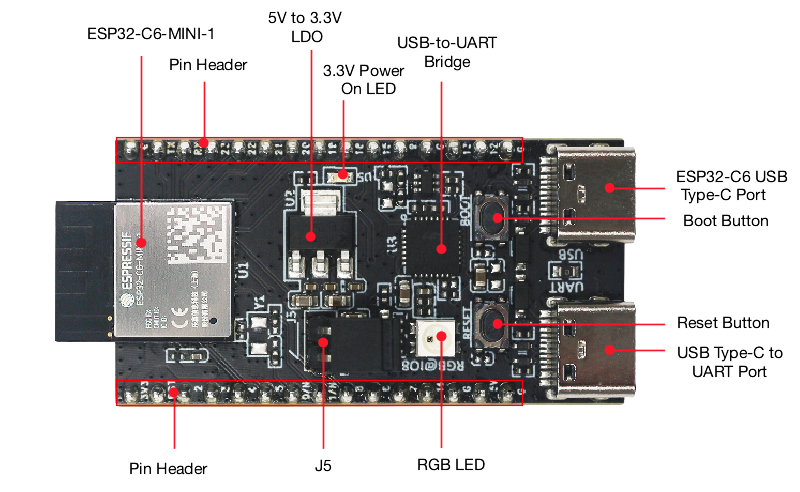
The Espressif ESP32-C6-DevKitM-1 is an official development board featuring the ESP32-C6-MINI-1 module, combining WiFi 6, Bluetooth 5 (LE), Zigbee, and Thread on a single chip. With IEEE 802.15.4 support, it is ideal for Matter-standard smart home devices, gateways between BLE or Zigbee sensors and home networks, as well as low-power battery-operated IoT nodes. The board features two USB-C ports – one via a USB-UART converter and the second directly on the native USB chip with a built-in JTAG debugger, allowing you to flash and debug the board using only a USB cable without an external probe. It can be programmed using ESP-IDF as well as the Arduino IDE (arduino-esp32 core version 3.0.0 or newer).
Specifications:
- Module: ESP32-C6-MINI-1 (ESP32-C6FH4 chip, PCB antenna)
- Processor:
- Main core: 32-bit RISC-V, up to 160 MHz
- Low power core (LP): 32-bit RISC-V, up to 20 MHz
- Memory:
- Flash: 4 MB (integrated in chip package)
- SRAM: 512 kB + 16 kB in the low power (LP) domain
- ROM: 320 kB
- Wireless connectivity:
- WiFi: 802.11 b/g/n/ax (WiFi 6), 2.4 GHz
- Bluetooth: Bluetooth 5 (LE)
- IEEE 802.15.4: Zigbee 3.0, Thread 1.3 (Matter compatible)
- Chip peripherals: UART, SPI, I2C, I2S, TWAI (CAN), LED PWM, MCPWM, RMT, 12-bit A/D converter, temperature sensor, SDIO slave
- USB:
- USB-C (UART): power supply, firmware upload, and serial communication via USB-UART converter (up to 3 Mb/s)
- USB-C (native): USB 2.0 Full Speed (12 Mb/s) – power supply, firmware upload, USB CDC, and JTAG debugging
- Power supply: 5 V via either USB-C port or 5V pin, or 3.3 V via 3V3 pin
- Logic level: 3.3 V (inputs are not 5V tolerant)
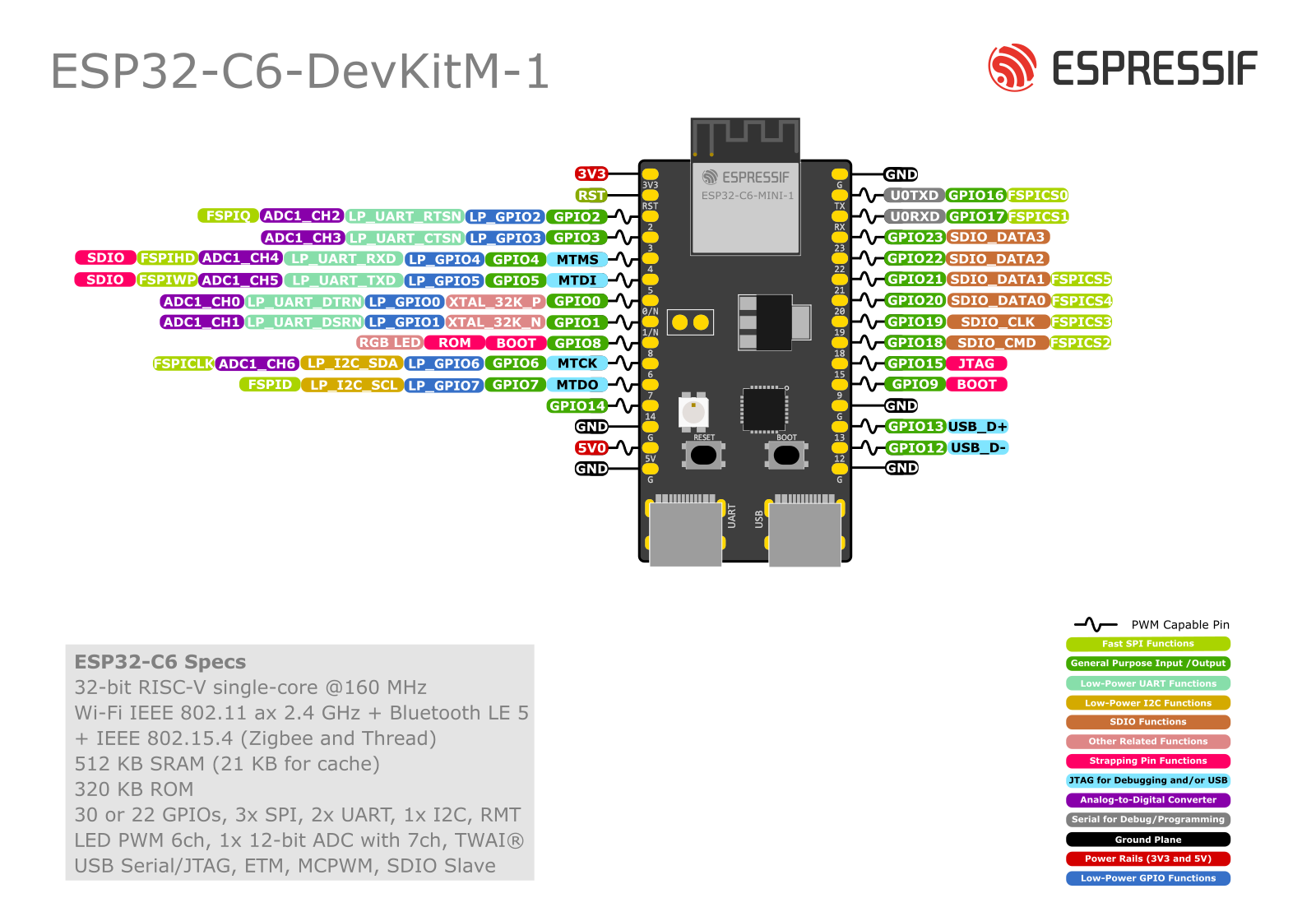
- Pins: 2× 15-pin header with 2.54 mm pitch – all available GPIO, 3V3, 5V, GND, and RST are routed
- On-board elements:
- BOOT button (hold and press RESET to switch the chip to upload mode)
- RESET button
- 3.3 V power supply LED indicator
- addressable RGB LED on GPIO8
- J5 jumper for measuring the module current consumption
- LDO regulator 5 V → 3.3 V
- Programming: ESP-IDF, Arduino IDE (arduino-esp32 ≥ 3.0.0), MicroPython
- Operating temperature: –40 °C to +85 °C
- Dimensions:
- Board: approx. 48.3 × 25.4 mm
Important wiring notice:
- GPIO4, GPIO5, GPIO8, GPIO9 and GPIO15 are strapping pins – do not load them with external pull-up/pull-down resistors or peripherals during startup, otherwise the chip may not boot correctly.
- GPIO12 and GPIO13 are native USB data lines (D− / D+). If you use them as general-purpose GPIOs, you will lose the native USB port including JTAG debugging.
- For JTAG debugging, the native USB-C port and OpenOCD from ESP-IDF are sufficient. Do not connect JTAG pins (GPIO4–7) freely to the rest of the circuit if you are not using an external JTAG probe.
- In the Arduino IDE, select the "ESP32C6 Dev Module" board and install the arduino-esp32 core version 3.0.0 or newer – older versions do not support the ESP32-C6 chip.
Package contents:
- 1× Espressif ESP32-C6-DevKitM-1
Note:
- This product is not a standalone functional unit and may require professional installation.
- Product images are for illustrative purposes only and may sometimes differ from the actual appearance of the item. However, this does not change their basic properties.
Additional parameters
| Category: | ESP Development Boards |
|---|---|
| Warranty: | 2 years |
| Weight: | 0.033 kg |
| Type: | ESP |
| Logical levels: | 3.3V |
| Frequency: | 160MHz |
| Flash memory: | 4MB |
| SRAM memory: | 512kB |
| EEPROM memory: | Ne |
| Connector with battery charger: | No |
| Microcontroller: | ESP32-C6 |
| Converter: | CP2102 |
| Bluetooth: | Yes |
| WiFi: | Yes |
| Ethernet: | Ne |


Product rating
The average product rating is 4,3 out of 5 stars.
4 ratings
5
4
3
2
1
Leave a rating
List of ratings
2
O
 Ondrej
 Ondrej
Hrozna deska. Vubec ESP32 je celkove hruza kdo nedela nejake zacatecnicke veci, kde staci copy&paste z Arduino IDE ale treba dela s RTOS a JTAG/SWD (10 let profesionalni vyvoj embedded). RTOS pluginy jinak v IDE jako Ozone nebo CLion umoznuji zobrazit stack vsech tasku.
Jako tahle doska me vytocila dost. JTAG - ten pravy konektor, nebo pres budto pres openocd od Espressif nebo profesionalni sondy jako JTrace (tam pres JTAG pinout) dela reset core procesoru dokola. Jeden kus jo, druhy ne.
Kdysi mi na ESP32 fungoval Flyswatter (v zasade FTDI nebo FTDI 2232H apod), ted smula. Starsi ESP32 desku zrejme brickl JTAG boundary scan obycejny, nehlasi se vubec ani na USB. Zlaty ARM a neco jako Cortex M33 misto tohodle.
5
F
Filip
 Filip
Filip
Deska už je kompatibilní s arduinem, stačí stáhnou desky arduino-esp32 v3.0.0, +recenze po roce provozu, desku mam zapojenou jako gateway mezi ble senzory na zahradce a svoji chytrou domacnosti, ve sleep rezimu prakticky nulova spotřeba a v provozu také nepřevíší 30mA, doporučuji
5
OP
Ondřej Pacovský
 Ondřej Pacovský
Doporučuji.
5
F
Filip
 Filip
Filip
Super, perfektní pro využití v chytré domácnosti. NEKOMPATIBILNÍ S ARDUINO IDE! Pokud vám to nevadí tak můžu jen chválit, nízká spotřeba, a super bezdrátové funkce.
Discussion
List of discussions
L
Arduino IDE
Lukáš
 Arduino IDE
Lukáš
Arduino IDE
Lukáš
Nekdo tu psal ze to neni kompatibilni s Arduino IDE, to uz neni pravda. Bezi to na verzi 2.3.1.
JK
Jakub Kubíšek
 Jakub Kubíšek
Už je i verze 3.0.0-a
vše funguje bez problému v Arduino-IDE